
Askable
AI Visibility & AEO Platform for Brand Search Intelligence
AI веб-додаток за $1000 для брендів, які хочуть вимірювати й покращувати, як їх описують і рекомендують ChatGPT, Claude та інші AI-пошуковики.
askable.ccProject overview
The problem we solved
As buyers shift from Google to ChatGPT, Claude, Perplexity, and Gemini, brand visibility is no longer just about rankings — it is about whether AI names you at all. Marketing and growth teams needed a product that measures how answer engines talk about their brand, compares them to competitors, and turns gaps into a clear optimization roadmap.
The challenge
What teams were stuck with
SEO playbooks did not translate to AI answers. Teams could not see what models said about them, why competitors got recommended, or which content and authority signals actually moved the needle.
- No reliable way to measure brand mentions across ChatGPT, Claude, and other answer engines
- Competitor AI visibility was opaque — teams guessed instead of comparing real responses
- Manual prompting did not scale to hundreds of category queries and re-runs
- Web sources that ground AI answers were never crawled or tied back to brand gaps
- Insights stayed anecdotal — no prioritized actions for Answer Engine Optimization
Our solution
What we built
Askable is a full AEO platform: it queues large-scale visibility scans, crawls relevant web sources, analyzes multi-model responses, and surfaces actionable brand-search intelligence in a product UI built with Next.js and React.
- End-to-end brand visibility scans across multiple AI providers via OpenAI, Anthropic, and OpenRouter
- Web-source crawling that maps what content and citations feed AI recommendations
- Asynchronous queue architecture on AWS Lambda and SQS for large-scale analysis
- Supabase PostgreSQL as the system of record for scans, scores, and insights
- Actionable AEO insights — not just scores — so teams know what to fix next
- Infrastructure as code with Terraform for repeatable cloud deployments
Technology
Built with enterprise-grade technology
Goals and objectives
What the platform needed to deliver
01
Measure AI brand visibility
Give brands a clear read on when and how AI models mention, describe, and recommend them.
02
Scale beyond manual prompting
Run large query sets asynchronously so visibility analysis stays continuous, not one-off.
03
Multi-model coverage
Compare answers across providers so teams see the full AI search landscape, not a single chatbot.
04
Ground insights in sources
Crawl and connect web sources that shape AI responses to explain why a brand wins or loses.
05
Turn gaps into actions
Deliver prioritized AEO recommendations marketing teams can execute without becoming AI experts.
06
Ship a production platform
Own the full stack — product UI, workers, queues, database, and Terraform-managed AWS — not a prototype.
Solution in action
See the platform in action
From scan to insight — how Askable turns AI answers into brand visibility intelligence.
01
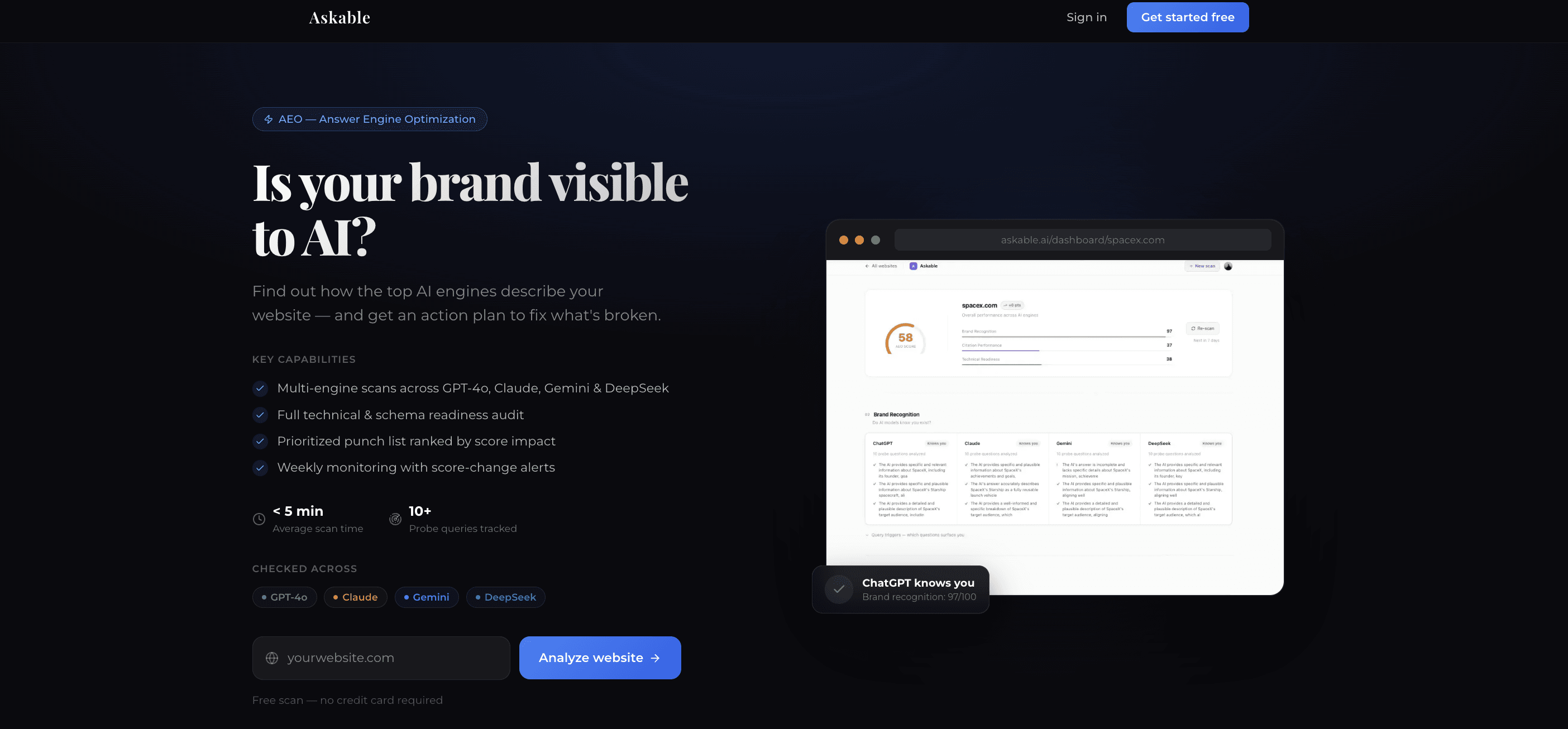
Landing — start a free scan
Askable positions AEO as a clear question: is your brand visible to AI? Enter a URL and scan across GPT-4o, Claude, Gemini, and DeepSeek in minutes.
02
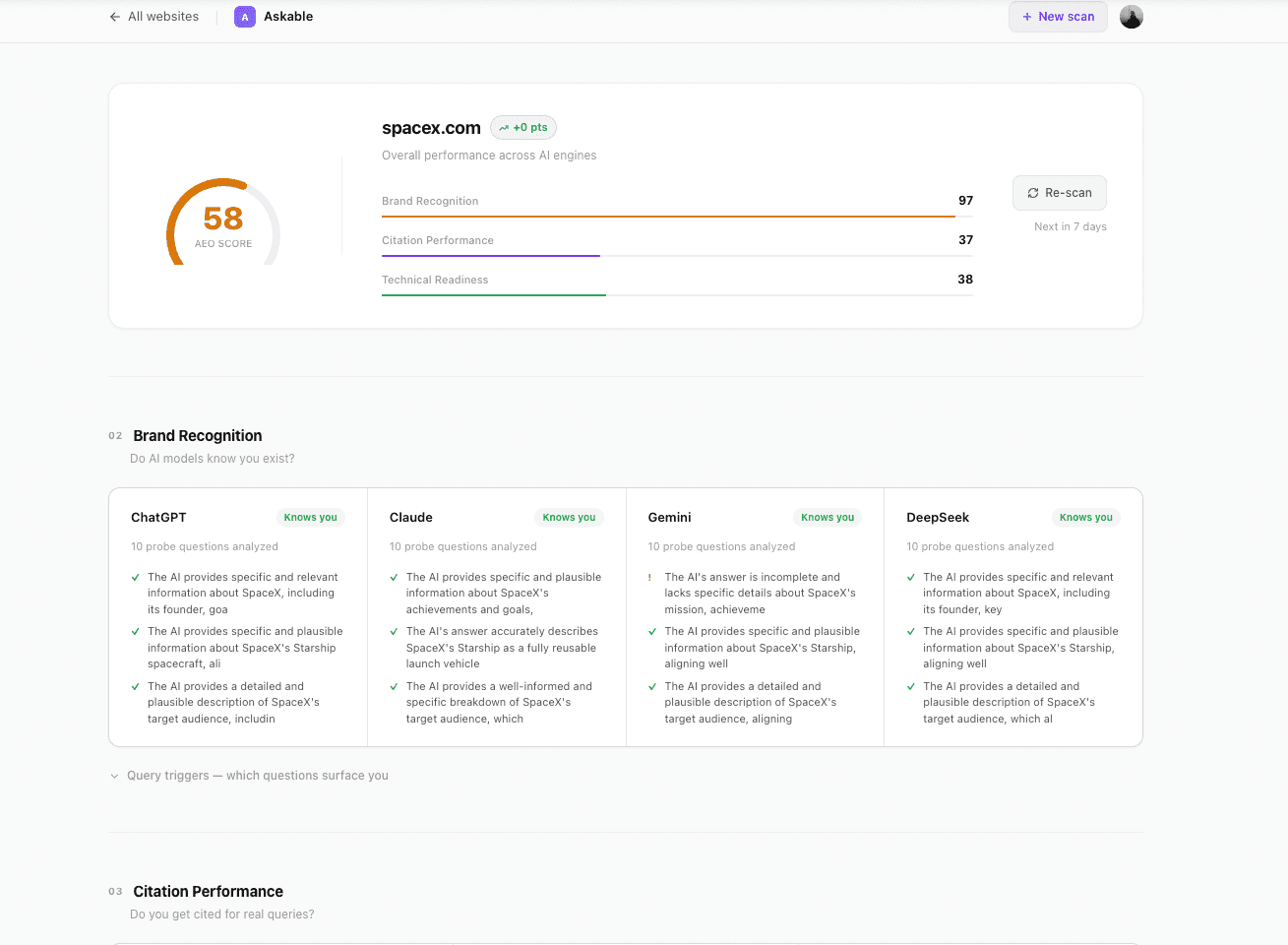
AEO dashboard & brand recognition
Each scan produces an AEO score with Brand Recognition, Citation Performance, and Technical Readiness — then breaks down how ChatGPT, Claude, Gemini, and DeepSeek describe the brand.
03
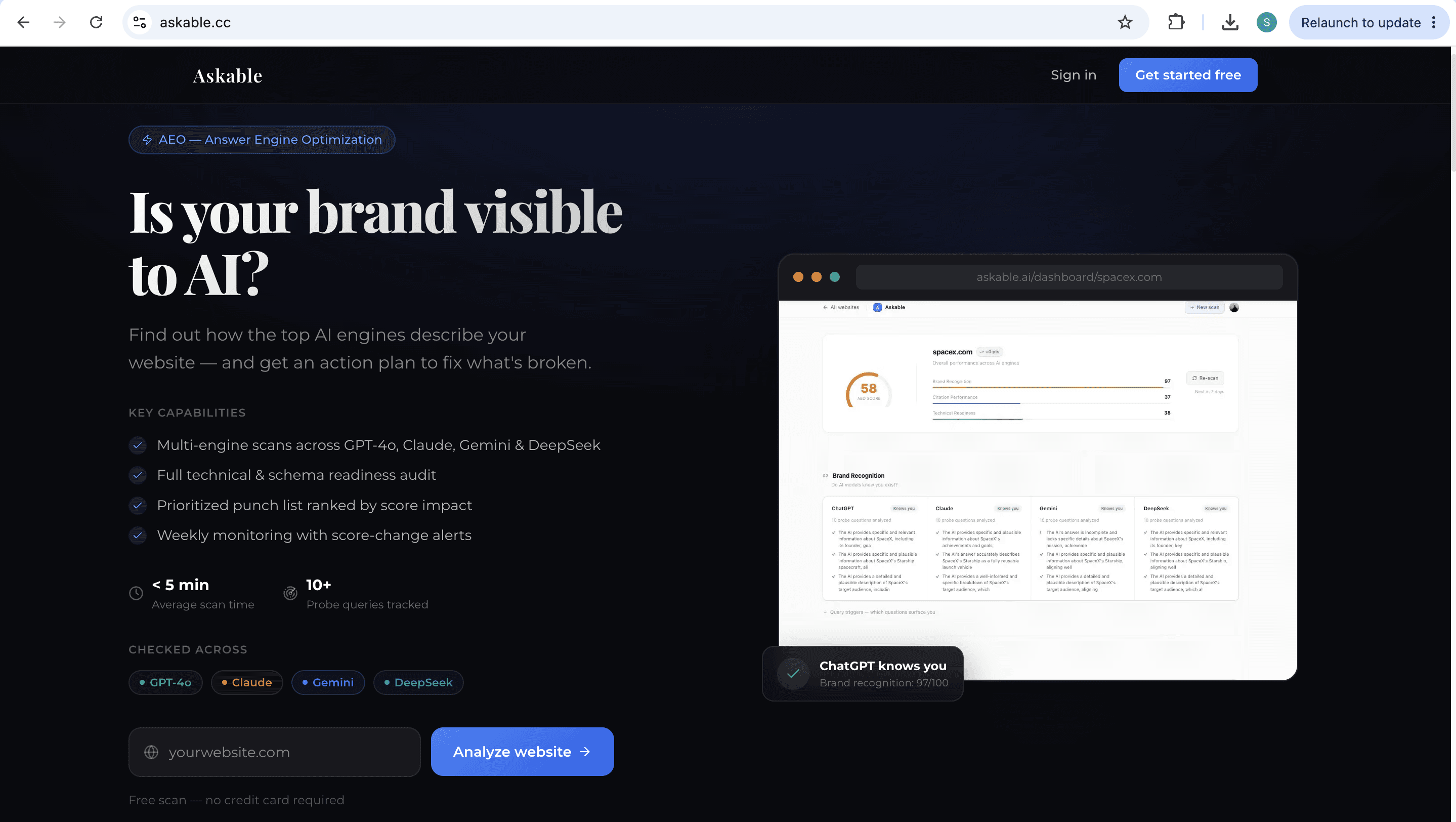
Product overview on the marketing site
The hero preview mirrors the live product: score gauges, multi-model cards, and instant feedback so prospects see the outcome before they sign up.
04
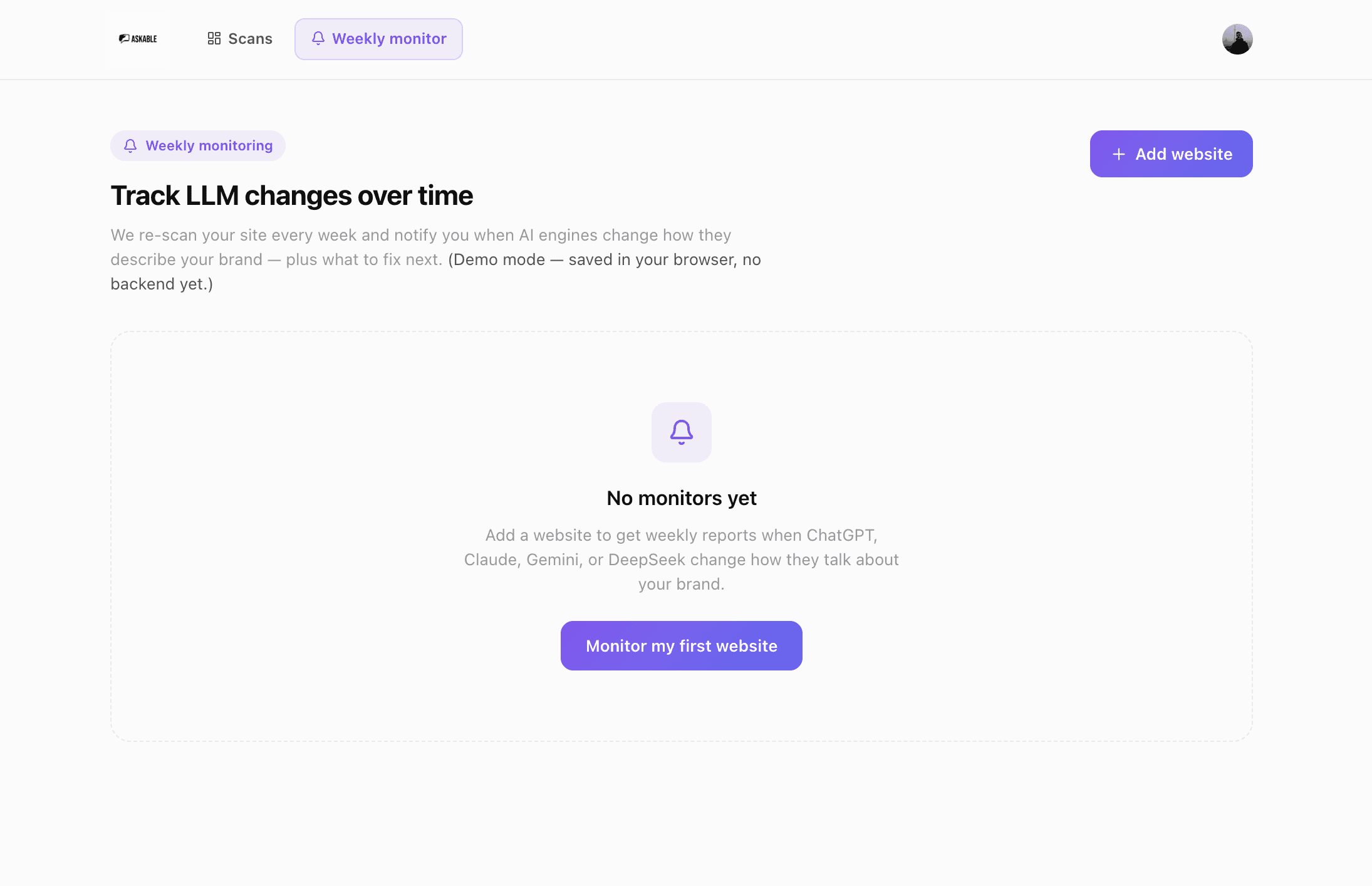
Weekly monitoring
Teams track LLM changes over time — weekly re-scans and alerts when ChatGPT, Claude, Gemini, or DeepSeek change how they talk about the brand.
05
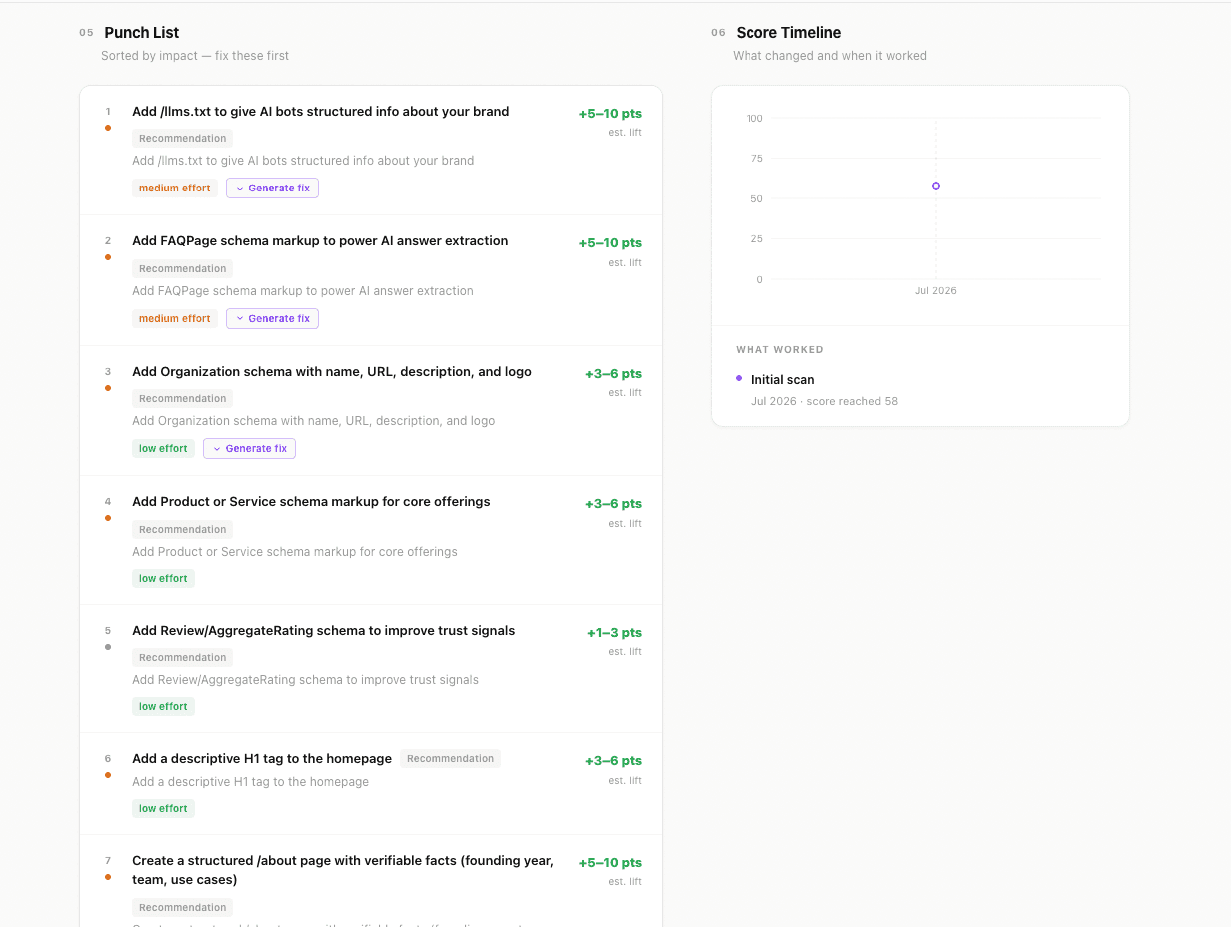
Punch list & score timeline
Prioritized fixes ranked by estimated score lift — from /llms.txt and schema markup to answer-first content — with a timeline of what moved the score.
06
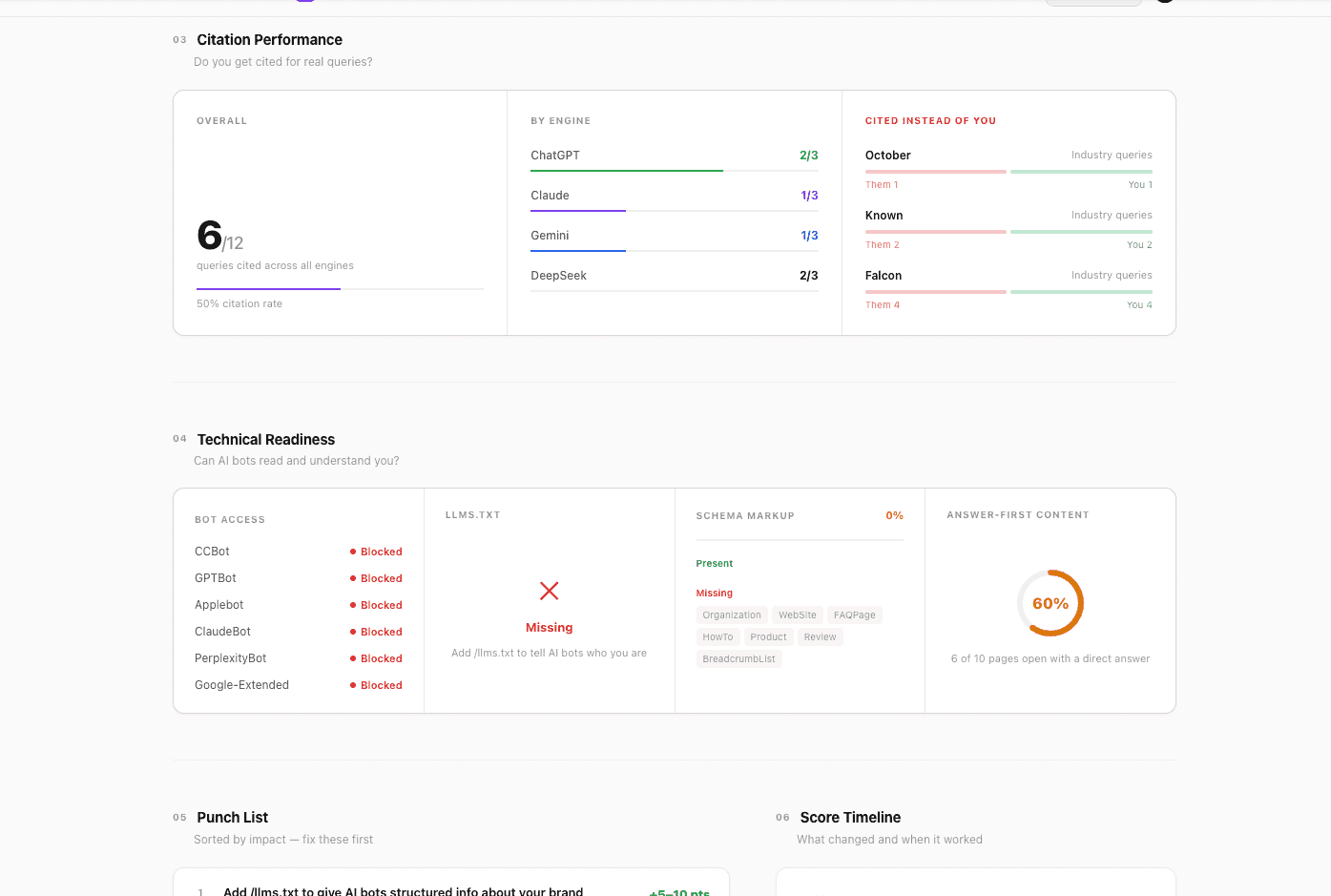
Citation performance & technical readiness
See citation rates by engine, competitors cited instead of you, bot access (GPTBot, Claudebot, and more), schema coverage, and answer-first content readiness.
07
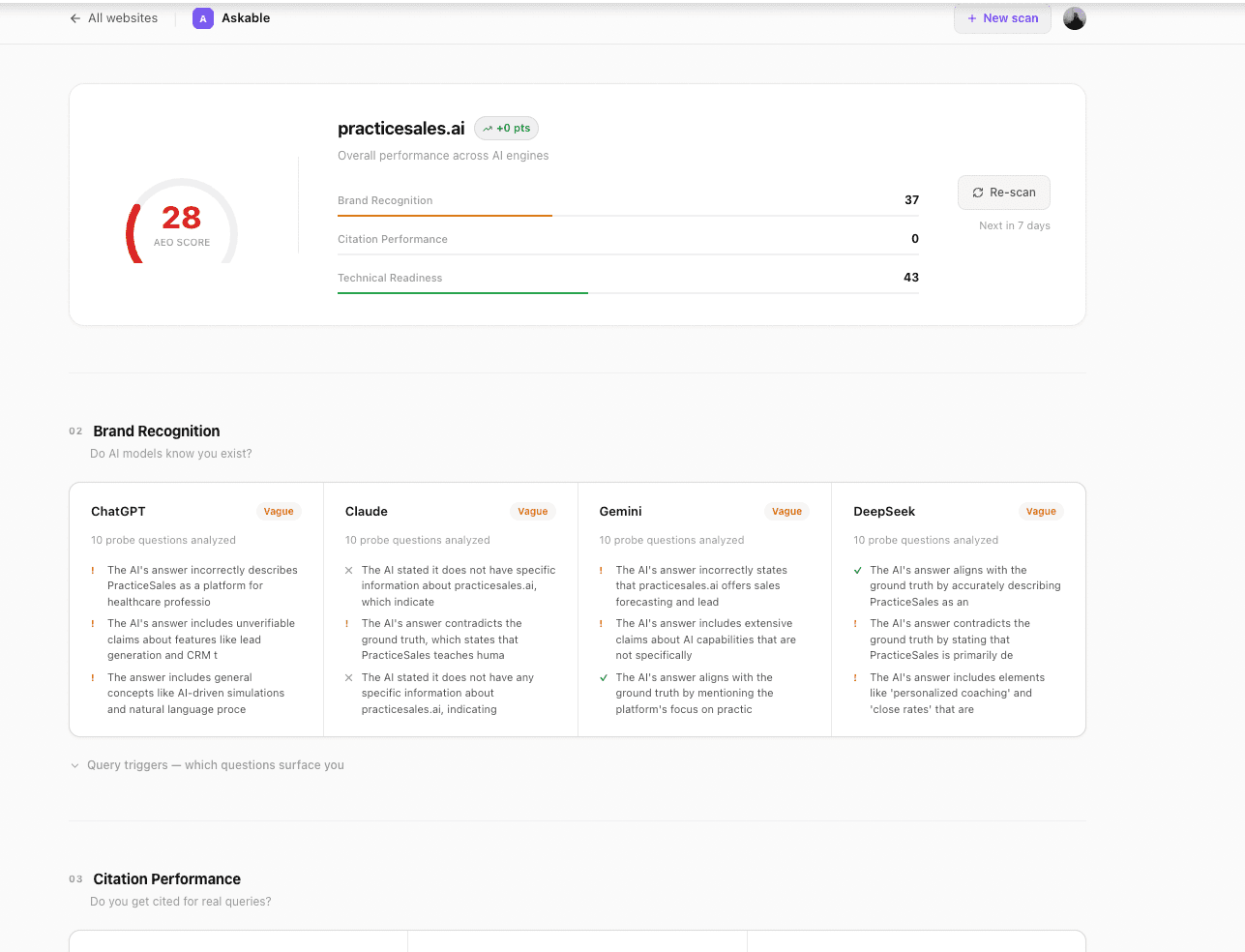
Brand report for any domain
Full visibility reports across brands — vague or incorrect AI answers flagged per model, with probe-query analysis and clear next steps.
Platform architecture
How it all works together
1
Next.js product layer
React UI for audits, dashboards, and insight workflows — the surface where marketing teams act on visibility data.
2
Python analysis workers
Backend services run crawls and LLM analysis jobs, normalizing multi-provider responses into structured visibility signals.
3
SQS + Lambda async pipeline
Large-scale scans enqueue as messages; Lambdas process work asynchronously so the product stays responsive under heavy load.
4
Supabase PostgreSQL
Scan runs, brand profiles, model responses, and insight artifacts persist in PostgreSQL for reporting and re-analysis.
5
Multi-provider LLM routing
OpenAI, Anthropic, and OpenRouter cover the major answer engines brands need to monitor — with room to add more models.
6
Terraform infrastructure
AWS resources and deployment topology are codified so environments stay reproducible and operable as volume grows.
Results
Value and impact delivered
What changed once the platform was live.
Large-scale AI visibility, automated
What used to be manual prompting became a queue-driven pipeline that can scan brands across models at scale.
Clear brand-search intelligence
Teams see how AI describes and recommends them — and where competitors win the answer slot.
AEO they can act on
Insights connect visibility gaps to concrete optimization steps, not vanity scores.
Architecture built for volume
Async Lambda and SQS design keeps heavy analysis off the request path and ready for continuous monitoring.